

Making gas distribution visible.
Analyze inhomogeneities.
Ensure process stability.Injection and Gas Mixture
Determine the Quality of Combustion
Early stages of the process determine subsequent operations
Before hydrogen or ammonia can be burned efficiently, stably, and with low emissions, they must be distributed safely, mixed homogeneously, and fed into the system in a reproducible manner.
However, it is precisely in this early phase of the process that inhomogeneities, concentration gradients, backflow, or local over-enrichment often occur, which later have a direct impact on flame stability, emissions, and operational safety.
LaVision makes it possible to capture these processes with spatial and temporal resolution—in situations where localized sensors cannot provide information about actual flow and mixing behavior.
Optimization, therefore, does not begin with combustion, but rather starts consistently with air injection, gas distribution, and mixing.
Well-informed process decisions are made before incineration
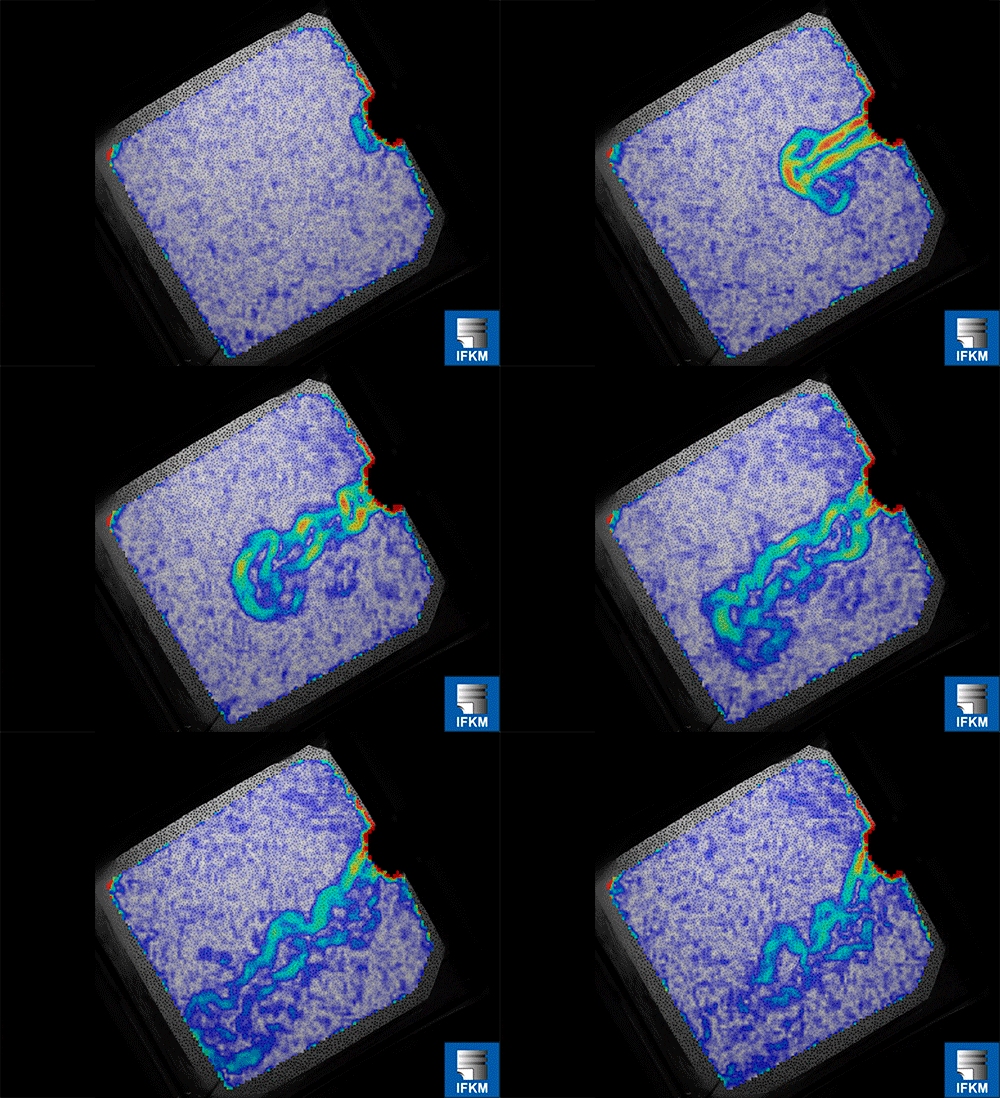
LaVision analyzes actual gas and flow conditions in injection and mixing sections under industrial operating conditions. In particular, the following become visible and can be quantitatively evaluated:
- Spatial Gas Distribution and Concentration Fields in Injection and Mixing Systems
- Flow paths, velocity fields, and recirculation structures
- Local inhomogeneities and concentration gradients
- Dynamic mixing processes during load changes or fuel switching
- Transient Effects and Non-Steady Flow Conditions
- Interactions Between Air Injection, Geometry, and the Downstream Combustion Process
This provides a solid basis for the technical evaluation of injection and mixing concepts even before they enter the flame zone.

Industrial Value-Added: Reliably Meeting Process Requirements
Industrial injection and mixing systems must meet defined requirements for homogeneity, stability, and reproducibility. What matters here is not the model assumption, but the actual state under operating conditions.
Optical metrology enables the quantitative validation of these requirements:
- Verification of mixing homogeneity across defined cross-sections
- Assessment of Safety-Critical Concentration Ranges
- Identification of Geometry-Induced Flow Instabilities
- Reproducible documentation for development, scaling, and CFD validation
This makes it possible to technically evaluate, compare, and optimize injection and mixing processes.

Why Optical Measurement Technology Is Essential for Gas Injection and Gas Mixing
Injection and mixing processes can only be monitored to a limited extent using conventional point sensors or purely mathematical models. These provide individual values or idealized assumptions, but do not capture either the spatial distribution or the temporal dynamics of real gas and flow conditions.
Optical metrology provides a full-surface, time-resolved view of injection, flow, and mixing—under real-world pressure, temperature, and geometric conditions. This not only reveals deviations but also their causes: inhomogeneities, transient effects, and local concentration gradients can be specifically analyzed and evaluated.

From Real Gas Conditions to Reliable Process Knowledge
LaVision visualizes actual gas and flow conditions where they are critical to the subsequent process: inside pipes, mixing sections, fuel supply lines, and injection zones.
Gas distributions of hydrogen, ammonia, or mixed gases, as well as concentration and density gradients and flow structures such as recirculation or dead zones, can be measured over a wide area and as a function of time—as can transient effects during load changes or fuel switching.
This visual documentation is not an end in itself: The measurement data is systematically evaluated quantitatively, analyzed in terms of space and time, and made comparable across different geometries, operating conditions, or fuels. In this way, the visualization yields reliable process knowledge that serves as the foundation for well-informed decisions, targeted optimization steps, and CFD validation.
Relevant Measurement Approaches & Optical Analysis Methods

Background-Oriented Schlieren (BOS)

SprayMaster inspex – Spray Pattern and Droplet Size Analysis

Particle Image Velocimetry (PIV)

Laser-Induced Fluorescence (LIF) & Tracer-LIF

Multiparameter Approaches
Typical Applications
Typical Optimization Goals
From the Gas Phase to Stable Combustion

Analyze Combustion & Emissions

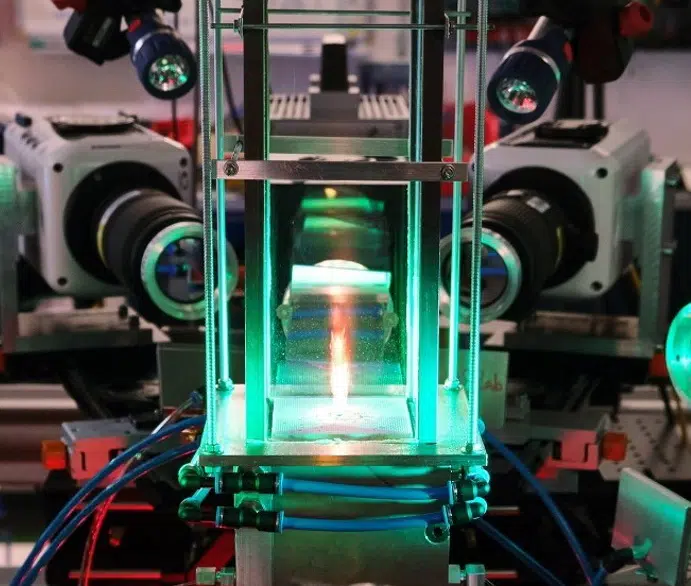
Ammonia Combustion Analysis
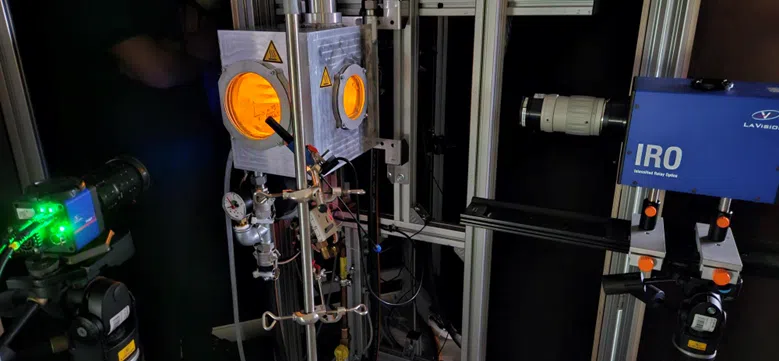
Frequently Asked Questions (FAQs) About Flow Visualization with LaVision FlowBOS
Why aren't traditional sensors sufficient for analyzing the gas mixture?
How is mixing homogeneity assessed quantitatively?
Can dynamic processes be analyzed during load changes?
Is the analysis also possible under actual pressure and temperature conditions?
How can CFD simulations be validated?
What role does the geometry of the injection play?
Which gases can be analyzed?
Targeted Analysis of Fuel Injection and Gas Mixture
Learn how to quantitatively measure and technically evaluate actual gas distributions, flow fields
, and mixing processes in your system.